Future of Work
Is Your Coworker Now an AI?
AI makes a great second brain. Just don’t let it become your first.
Read the full article on Write A Catalyst
Overview
A non-technical piece, and my first on Medium in a year. AI already works beside most of us, not only programmers, and the evidence says it helps: support agents with an AI assistant resolved 15% more issues per hour, and people working alone with AI matched teams working without it. Used well, it is an extra coworker and a second brain, the same cognitive offloading we already do with saved phone numbers and to-do lists.
The essay is about the moment that help quietly turns into replacement. It walks through three warning signs: the productivity illusion (developers who were 19% slower with AI still believed they were 20% faster), the outsourced brain (the more thinking we hand over, the less we use it), and workslop, the polished AI text that makes colleagues trust the sender less. Then it asks the uncomfortable question: if we hand over the thinking, the judgment and the writing, what is left that makes us different from the tool?
It ends with three habits I use to stay the one in charge, each backed by a cited study.
Key takeaways
- You lead, AI assists: write the first draft yourself, then ask AI to polish and critique it. People learn most when they attempt a problem before reading the AI’s answer.
- Delegate tasks, keep the judgment: hand over specific, repetitive work and keep the decisions.
- Don’t doomscroll while it works: switching away leaves part of your attention behind. Read its reasoning, or take a short walk.
- Feeling faster with AI is not the same as being faster.
- Your coworker can be an AI. Just make sure you aren’t one.
Figures from the article
-
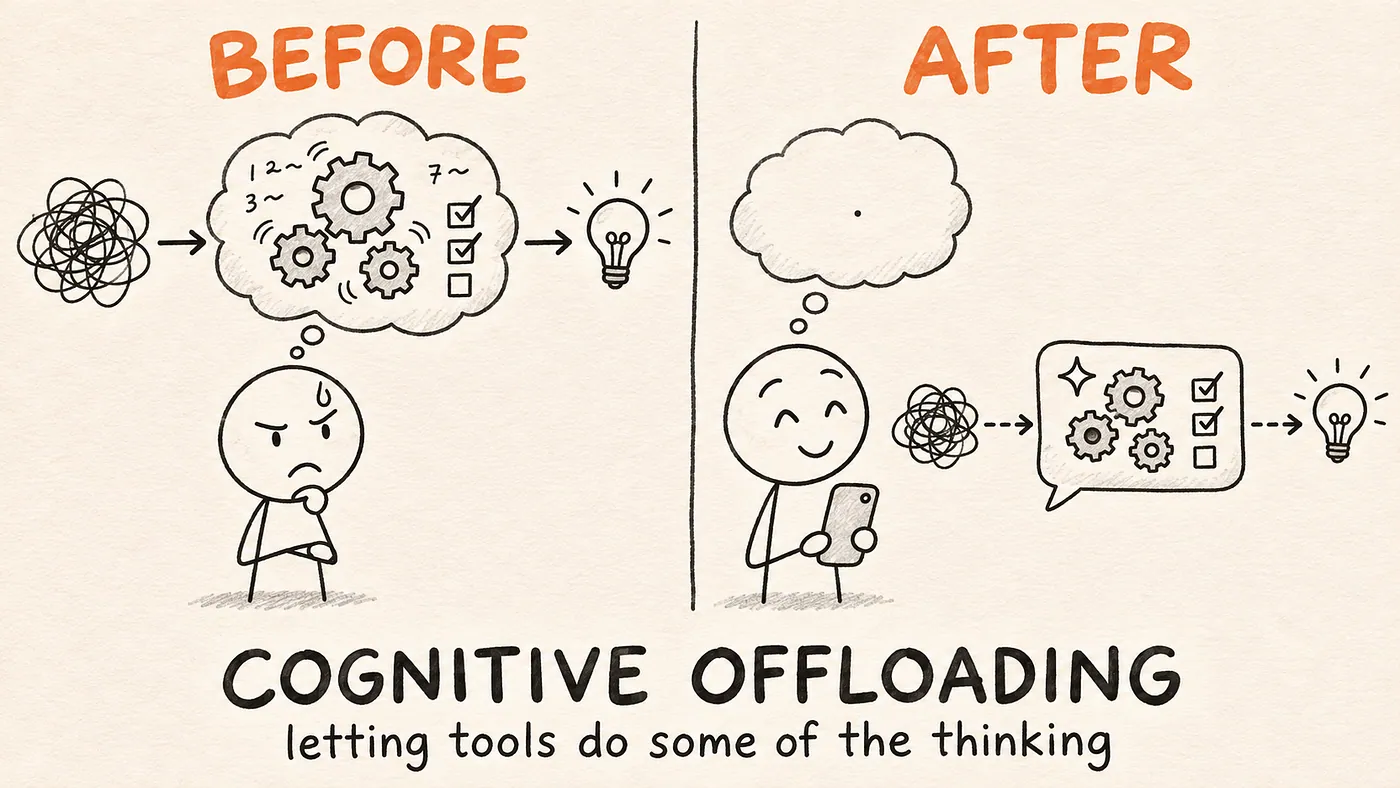
Cognitive offloading: letting tools do some of the thinking (AI-generated image).
Resources
- Brynjolfsson et al. (2025) Cited study
- Dell’Acqua et al. (2026) Cited study
- Risko & Gilbert (2016) Cited study
- Becker et al. (2025) Cited study
- Gerlich (2025) Cited study
- Lee et al. (2025) Cited study
- Kosmyna et al. (2025) Cited study
- Dahmani & Bohbot (2020) Cited study
- Niederhoffer et al. (2025) Cited article
- Jakesch et al. (2019) Cited study
- Hohenstein et al. (2023) Cited study
- Kumar et al. (2025) Cited study
- Fügener et al. (2022) Cited study
- Leroy (2009) Cited study
- Irving et al. (2024) Cited study
- McDaniel et al. (2025) Cited study
Continue reading “Is Your Coworker Now an AI?” on Write A Catalyst
More writing
- Building Conditional LLM Agent Workflows with LangGraph Level Up Coding · LangGraph
- How Multimodal AI Actually Works: CLIP, Vector Embeddings & LLMs Explained AI Advances · Multimodal AI · 14 min read
- Building a RAG-Powered Hackathon-Winning App Level Up Coding · RAG · 12 min read
- All articles → Agents, retrieval, Flutter and working with AI